06 Archives
Where the source went
Source code survives by accident far more often than by design, on a disc in somebody's loft rather than in a repository.
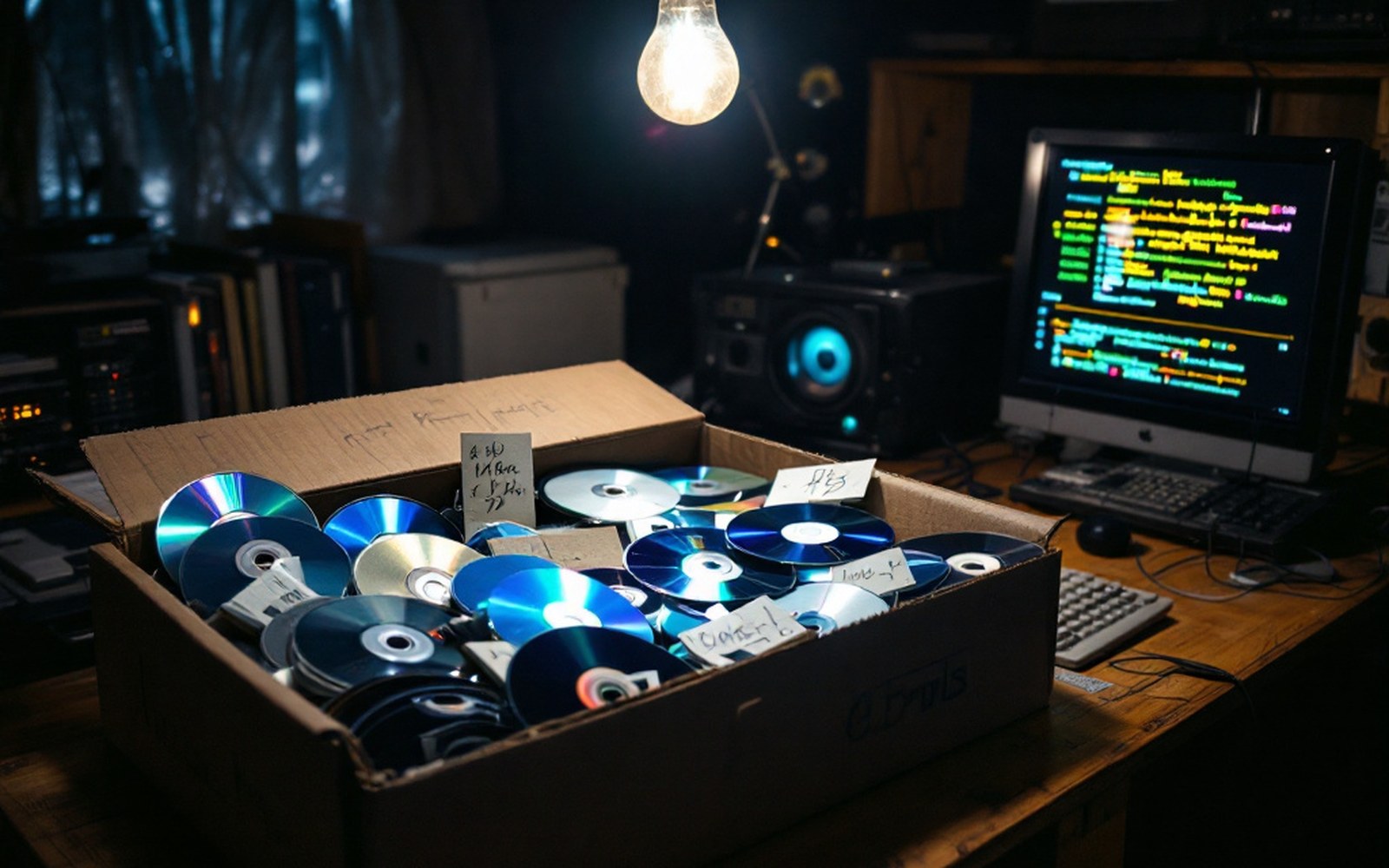
Handwritten labels, no index and no backup: how most source code actually survived.
oujouer.com collection
Why survival is an accident
The source code is not the game. It is the set of instructions from which the game was compiled — the human-readable layer that lets a programmer read, modify and rebuild. A compiled binary runs; source code explains. For preservation, that distinction matters enormously: with source you can recompile for a new architecture, fix a bug, understand a design decision. Without it, you are left emulating or reverse-engineering from the executable alone, working backward from an answer to reconstruct the question.
Browser games complicated this further. Flash's ActionScript, Java applet source, Shockwave Lingo — these were authored in proprietary tools by individuals or tiny teams, often without version control, often on a single machine. When a studio folded, a hard drive died, or a developer simply moved on, the source went with them. What the Internet Archive holds, what BlueMaxima's Flashpoint has collected at scale, is almost entirely compiled output: the SWF file, the JAR, the DCR. Runnable, in the right environment, but not readable in the way source is readable.
The browser-game era compounded a pattern already visible in the earlier history of digital games. Historians and archivists have long noted that the 1980s home-computer industry lost much of its source archives through simple neglect — no policy, no deposit, no one whose job it was to care. Browser games repeated this at speed and volume.
The loft, the hard drive, the mailing list
What survives does so by accident. A programmer kept a backup CD because they were tidy. A studio's final employee took a ZIP of the codebase when they left, meaning to do something with it, and never did. A game-jam winner uploaded their source to a forum that happened to stay online. These are the real mechanisms of software survival: individual habit, not institutional design.
When source does surface, it tends to surface dramatically. The source code for MUD1 — the persistent shared world Roy Trubshaw and Richard Bartle built at the University of Essex beginning in 1978 — was preserved partly because the academic context imposed a kind of informal custody. University machines had backups; tapes survived; the authors remained in contact with institutions that cared. Commercial browser-game studios had none of that. Their source followed the money, and the money ran out.

The shelf is the easy half. Something has to still be able to read what is on it.
oujouer.com collection
The Video Game History Foundation has made the survival rate of commercial games generally its explicit subject, concluding from library and archive research that a substantial majority of games released before the digital distribution era are wholly unavailable today in any form. Source code survival is a subset of that crisis, and the subset is smaller still. The foundation has pressed for copyright exemptions that would allow libraries to preserve and provide access to out-of-print software, with partial success in subsequent rulemakings.
What the archives can and cannot do
The Internet Archive's software collections, the Computer History Museum's holdings in Mountain View, and university digital preservation programmes hold what was deposited with them or donated after the fact. The gaps are not failures of curation — they are failures of acquisition, which is a different problem. You cannot catalogue what was never given to you.
The Ruffle project and the broader emulation approach sidestep the source problem partly by design: if you emulate the runtime rather than the game, the compiled output is enough. The game runs without its source being present or even known. This is elegant and practical, and it is also a ceiling. Emulation preserves the experience; it does not preserve the craft or enable the scholarship that source code would allow.
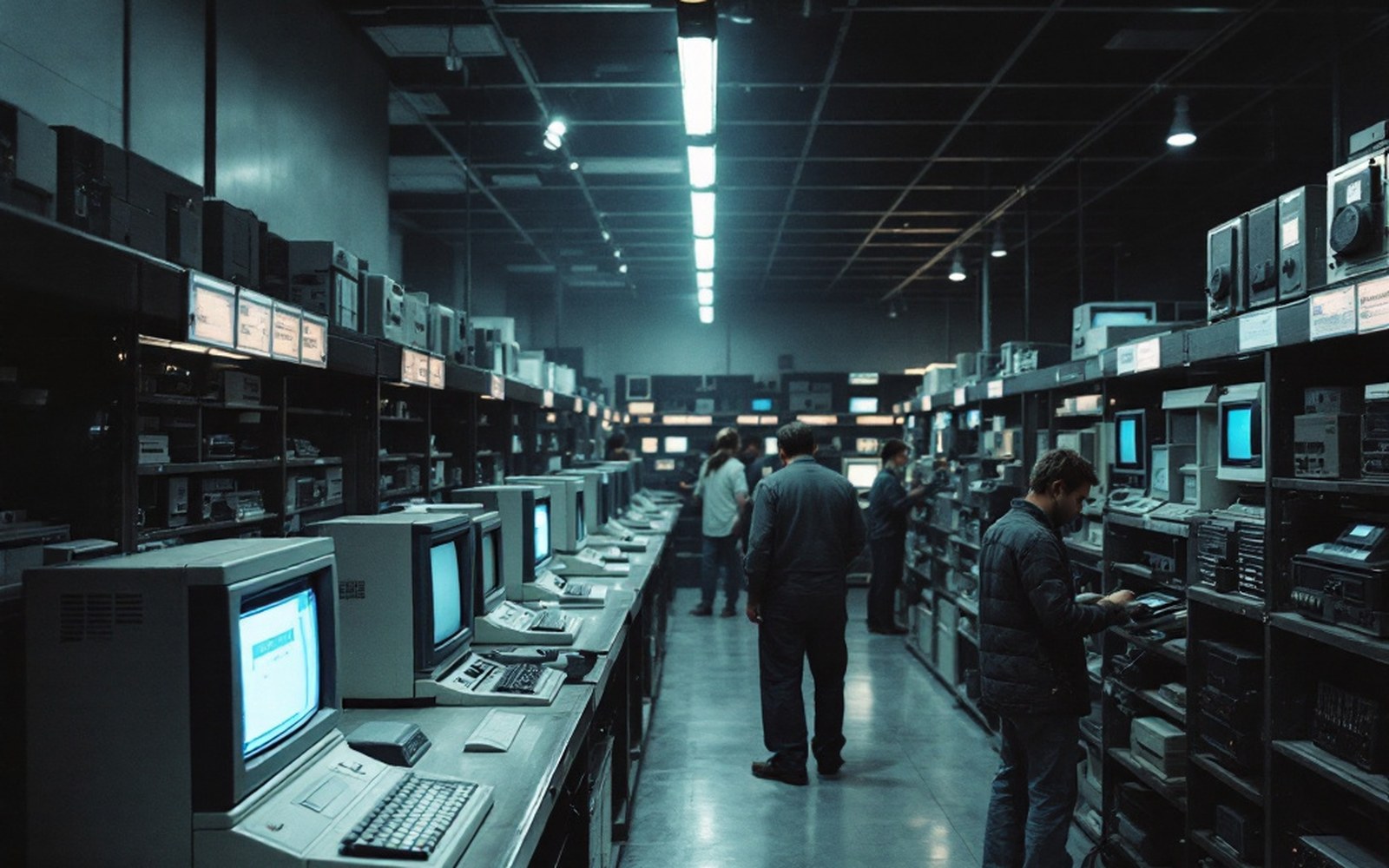
Accession labels are what turn a shelf of dead machines into a collection.
oujouer.com collection
Some source has re-emerged through deliberate disclosure — developers releasing code under open licences years after a game's commercial life ended. The Internet Archive has received several such donations. Others have appeared on GitHub, posted by former developers without fanfare, sometimes in violation of agreements they no longer considered binding. The legal status of these releases is often murky; the preservation value is immediate.
The honest summary is that source code from the browser-game era survives in proportion to how much an individual developer valued it, not in proportion to how much the work deserved to last. That is not a policy. It is the record of having had no policy at all.
It is the set of instructions from which the game was compiled — the human-readable layer that lets a programmer read, modify and rebuild.

One machine, many doors. Every terminal in the row was logged into the same world.
oujouer.com collection