01 The Text Era
MUD1 at Essex
In 1978 Roy Trubshaw and Richard Bartle wrote a persistent shared world made entirely of text at the University of Essex, and everything multiplayer descends from it.
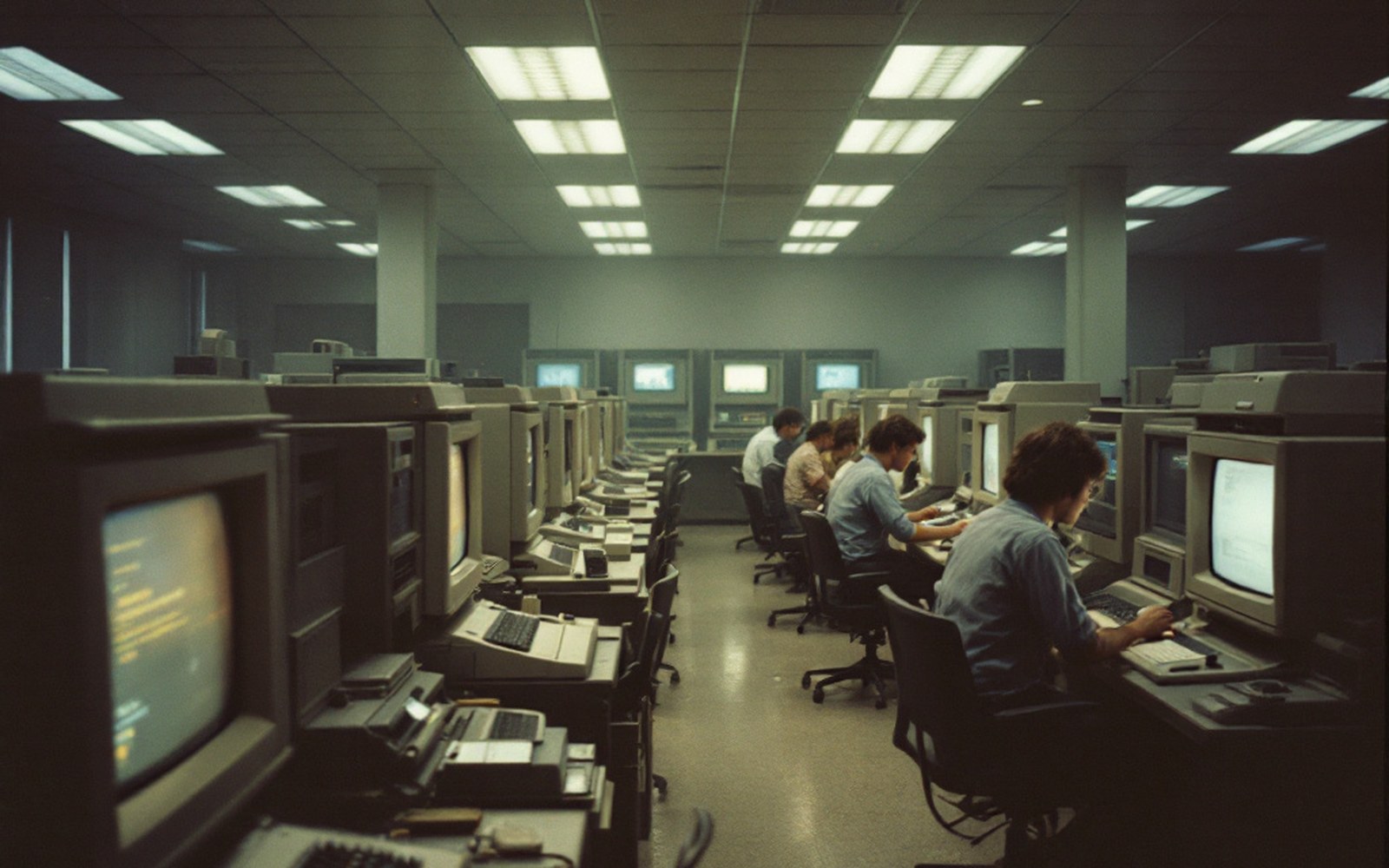
Institutional hardware doing unsanctioned work: the first shared world ran on the university’s own timesharing machine.
oujouer.com collection
The program Roy Trubshaw wrote in a corridor
The University of Essex sits on a ridge above Colchester, a provincial English city that styles itself the oldest recorded town in Britain. In 1978 the university's computing facilities ran on a DEC PDP-10, a machine whose architecture was already middle-aged by the standards of the era. Roy Trubshaw was an undergraduate there, and he used that machine to write a persistent shared world — a program in which multiple people could log in over a network connection, move through rooms described in plain text, pick up objects, and encounter one another in real time. He called it MUD, for Multi-User Dungeon. The name was a nod to the single-player text adventure Dungeon, a game also known as Zork, itself descended from Will Crowther and Don Woods's original Colossal Cave Adventure, and the nod was deliberate: Trubshaw was extending the single-player room-and-parser model into something genuinely social.
The first version was written in MACRO-10, the assembly language of the PDP-10, and it was functional rather than finished. Trubshaw rewrote it in a higher-level language of his own devising — MUDDL, the MUD Definition Language — which allowed the game world to be described declaratively rather than hard-coded into the executable. That architectural choice, separating the engine from the content it ran, would echo through every virtual world built afterward. Before he graduated, Trubshaw handed the project to Richard Bartle, a fellow student who was already collaborating with him on the design. Bartle expanded the world, deepened the mechanics, and kept the program running on Essex's systems.
What made MUD qualitatively different from its single-player predecessors was not the text — text adventures were already well established — but the persistence and the shared presence. The world did not reset between sessions. Objects moved by one player stayed where they were left for the next. Players could help each other, fight each other, and talk to each other in a shared space that continued to exist whether or not anyone was logged in. These properties, obvious in retrospect, had not been combined before in a publicly accessible networked environment.
The ARPANET connection and the spread of the model
Essex gained access to ARPANET in 1980, and MUD became accessible to users far beyond the university's own dial-up lines. That connection changed the nature of what Trubshaw and Bartle had built: it was no longer a campus curiosity but a networked game available to anyone with an account on a connected machine. Players arrived from universities across the United States and from research institutions in Europe. For some of them it was the first genuinely multiplayer game they had ever encountered.
Bartle and Trubshaw licensed the game commercially through a company called MUSE Ltd in the early 1980s, and a version ran as a paid service on British Telecom's Prestel network and later on CompuServe. The commercial version was known as British Legends in some markets. The distinction between the original academic program and the commercial product is historically important: the Essex source code remained in a different lineage from the ports and derivatives that spread outward, and for many years the specific version known as MUD1 — the Essex original — was treated as something close to a canonical text.

The parser answered in sentences, so the printed listing beside the screen was part of the game.
oujouer.com collection
The program's influence did not spread through licensing so much as through imitation and extension. People who had played MUD went away and wrote their own versions. The lineage is dense: TinyMUD, AberMUD, DikuMUD, LPMud, and eventually MUSH, MUCK, MUSE, and the MOO family all trace some part of their architecture back to decisions made on that PDP-10 at Essex. Each variant made different choices about combat, building rights, and what players were permitted to do to the world and to each other. The combinatorial explosion of MUD derivatives throughout the 1980s and 1990s was one of the defining phenomena of networked computing before the web existed.
What Bartle's analysis added
Bartle's contribution was not limited to code. In 1996 he published a paper — based on years of watching how different players engaged with MUD — that proposed a taxonomy of player motivations: achievers, explorers, socialisers, and killers. The paper was widely read, widely cited, and widely misapplied; it was meant as a description of behaviour observed in a specific text environment, not a universal theory of game design. But it had the effect of making the study of player behaviour in online worlds a legitimate subject of inquiry, and it introduced a vocabulary that game designers were still reaching for decades later when they built massively multiplayer online games that Bartle's PDP-10 could not have imagined running.
The historical record here is solid. Richard Bartle's own account of MUD's development has been publicly available for many years and is unusually well documented for a piece of computing history from that era. The program was written at a specific institution, on specific hardware, by two named people, in a two-year window that is not disputed. That clarity is rarer than it sounds: much early software history survives only as folklore.

The notes on the wall are the giveaway: in a MOO the players were writing the rooms they stood in.
oujouer.com collection
The preservation question
What does it mean to preserve MUD1? The question is less straightforward than it appears. The original program ran on a PDP-10, a machine that no longer exists at Essex and that requires either physical hardware or software emulation to run. The Computer History Museum holds PDP-10 hardware and documentation, and a community of enthusiasts has maintained software emulators for the architecture for decades. Running MUD1 today means running it inside an emulated PDP-10, which is precisely the model — emulate the runtime, not just the game — that has become the standard approach for software preservation more broadly.
The Internet Archive in San Francisco holds materials relating to early networked computing, and the trajectory of MUD's preservation sits within a wider institutional effort to treat software as a primary historical record rather than an ephemeral product. The Video Game History Foundation has argued publicly that the vast majority of games from the pre-web era are commercially unavailable and survive only in fragile or incomplete form. MUD1 is not commercially unavailable — versions of it have been accessible online at various points — but the question of which version, running on which emulated hardware, faithfully represents what players encountered at Essex in 1980 is a genuine archival problem rather than a solved one.
The University of Essex sits on a ridge above Colchester, a provincial English city that styles itself the oldest recorded town in Britain.
Pavel Curtis, who built LambdaMOO at Xerox PARC in 1990, inherited a direct intellectual debt to the Essex work. LambdaMOO's architecture — a programmable object-oriented world in which players could extend the environment itself — was a substantial evolution of the MUD model, but it began from the same premise: a persistent shared world described entirely in text, in which presence and action were mediated through language. The path from Trubshaw's MUDDL to Curtis's MOO core is not a straight line, but it is a traceable one.
Everything that came after — the graphical MMORPGs, the persistent online worlds, the social platforms that adopted spatial metaphors — descends in some way from the decision made by a student on a university ridge above Colchester to let two people inhabit the same fictional room at the same time. The mechanism was a DEC mainframe and a dial-up line. The consequence was the architecture of shared virtual space.

Four corners drawn by hand, two decades before anyone said the words player analytics.
oujouer.com collection