01 The Text Era
MOOs
Object-oriented shared worlds let the inhabitants build the world while they were living in it, which turned out to matter more than the graphics did.

The notes on the wall are the giveaway: in a MOO the players were writing the rooms they stood in.
oujouer.com collection
Rooms that built themselves
A MOO — MUD, Object-Oriented — is a text-based shared world in which the objects are not static set dressing but programmable entities that any sufficiently trusted inhabitant can write and modify. The distinction sounds technical; in practice it meant that a MOO's users were also its architects, and the world grew laterally, organically, in directions no designer had anticipated.
The form was established by LambdaMOO, created by Pavel Curtis at Xerox PARC in 1990. Curtis built a virtual Xerox Palo Alto house and then handed the programming tools to whoever logged in. Within a few years the space extended far beyond any architectural metaphor, populated with objects, rooms and behaviours its original author had never specified. The database that defined the world was itself a living document, versioned by collective labour.
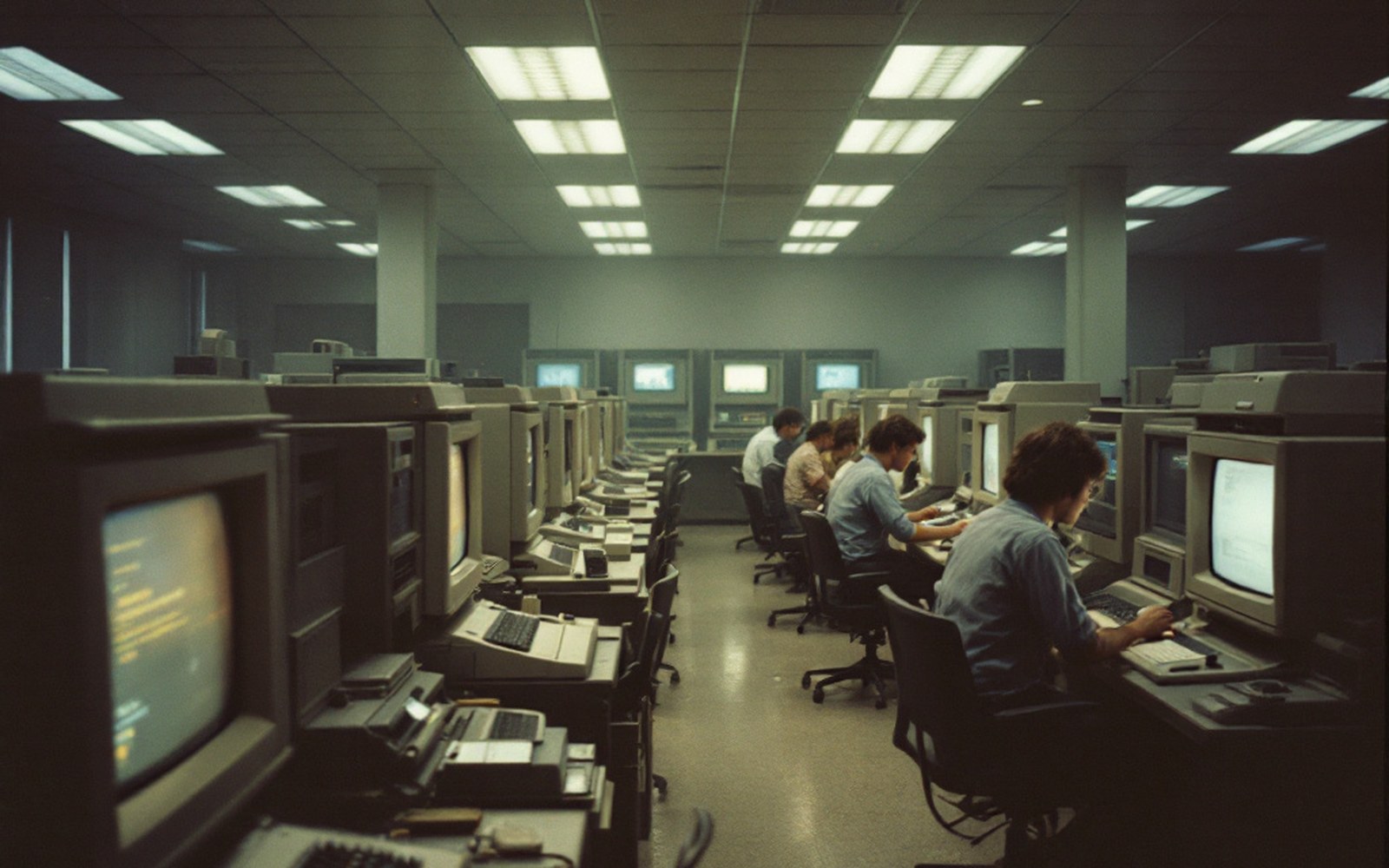
Institutional hardware doing unsanctioned work: the first shared world ran on the university’s own timesharing machine.
oujouer.com collection
What distinguished MOO programming from the earlier MUD tradition — Roy Trubshaw and Richard Bartle's MUD1 at Essex, and the lineage of zone-file worlds that descended from it — was the object hierarchy. Everything in a MOO inherits properties from a parent object; a user creating a new kind of door or lamp or conversation partner could build on existing behaviour rather than coding from nothing. The language, MOO-code, ran server-side and was accessible from within the client connection itself: you programmed the world from inside it, using the same telnet session you used to walk through it.

The parser answered in sentences, so the printed listing beside the screen was part of the game.
oujouer.com collection
The academic world noticed. MediaMOO, run out of MIT's Media Lab from 1993, was designed explicitly as a professional gathering space for media researchers. BioMOO hosted biology conferences. Diversity University MOO was used for distance education. These were not games in any commercial sense; they were synchronous collaborative environments that happened to be built on game infrastructure, and institutions adopted them because the infrastructure was free, open and already understood by the people using it.
Curtis built a virtual Xerox Palo Alto house and then handed the programming tools to whoever logged in.
The browser did not kill the MOO so much as sideline it. As graphical interfaces became the default expectation for shared online spaces through the late 1990s, the telnet-accessible text world lost institutional momentum. The objects and rooms persisted — LambdaMOO itself has continued running without interruption — but the culture of building them migrated toward richer runtimes. What the MOO proved, and what later platforms quietly relied on without acknowledgement, is that users given construction tools will extend a world far beyond its original scope, and that this extension is itself the content.

Four corners drawn by hand, two decades before anyone said the words player analytics.
oujouer.com collection