04 The End of Flash
The 2017 notice
The end was announced more than three years ahead, which is more warning than most platforms give and still was not enough.
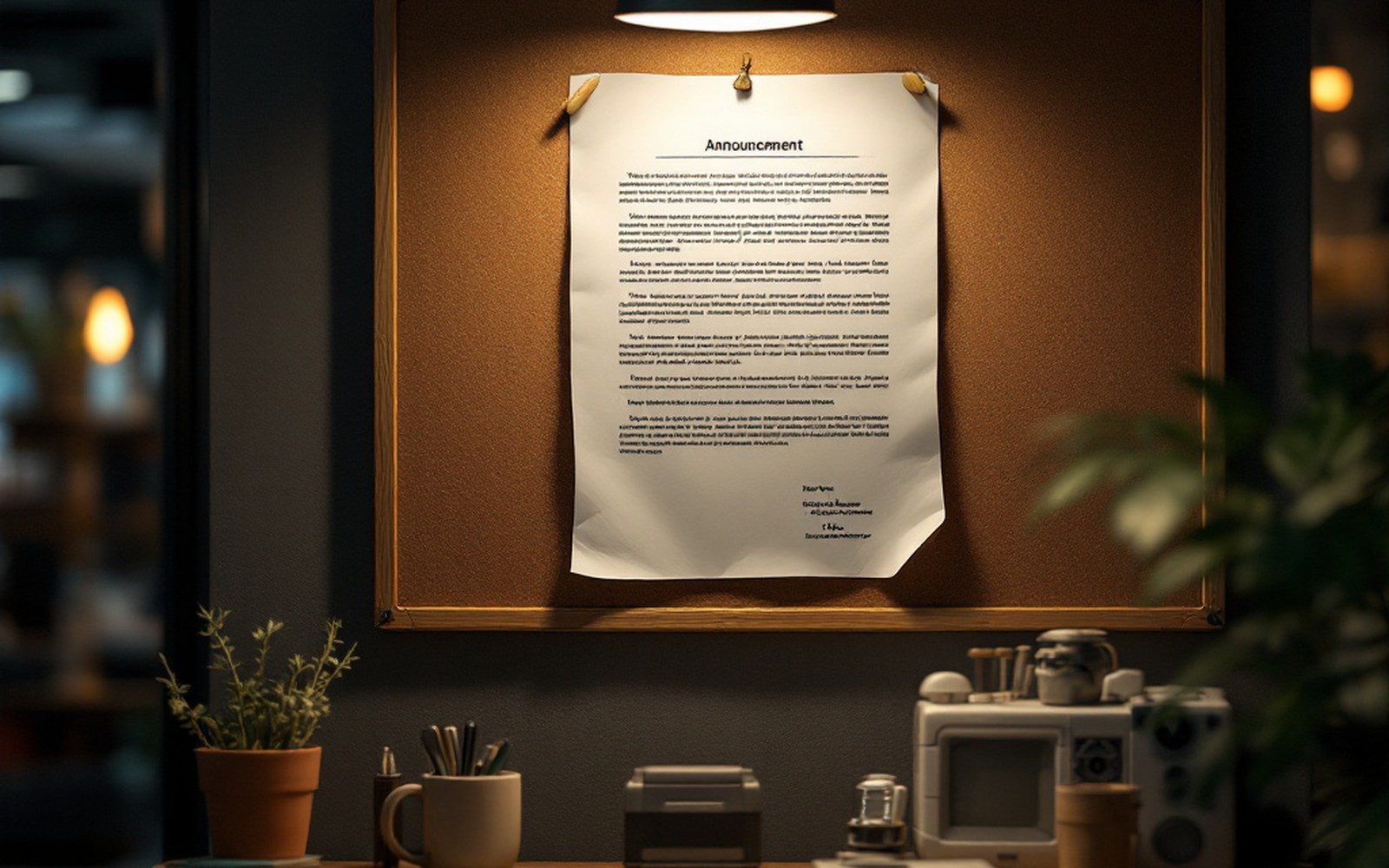
Three and a half years of warning, pinned up and largely filed.
oujouer.com collection
Adobe gave three years' warning, and the web was still not ready
In July 2017, Adobe announced that it would end support for Flash Player on 31 December 2020. Three and a half years of advance notice — more runway than almost any platform transition in the industry's history. And when the date arrived, tens of thousands of games became unplayable within hours.
The announcement itself was coordinated. Adobe did not act alone: Apple, Facebook, Google, Microsoft and Mozilla all signed on to the same statement, each committing to phase Flash out of their products on the same schedule. The joint framing mattered. It meant browser vendors would remove or disable the plugin through their own update mechanisms, that mobile platforms would continue their existing refusal to support it, and that enterprise software teams had a fixed date to plan around. The industry presented a united front specifically to forestall the kind of protracted, ambiguous decline that had made earlier plugin deaths so messy.
The reasoning was equally clear. Flash's security record had been genuinely poor for years — not a single bad year, but a decade of critical vulnerabilities patched in quarterly cycles that never quite caught up with the attack surface. Adobe's own language in the announcement pointed to the maturation of open standards: HTML5, WebGL and WebAssembly were now capable of doing most of what Flash had required a proprietary runtime to do. The message was that the web had grown up around Flash and no longer needed it. That was partly true and partly a convenient narrative, but it gave the announcement a logical shape.
What it did not account for was the archive. The transition planning assumed active developers with active codebases — studios and agencies that could migrate, publishers that could commission ports, platforms that could update their catalogues. It did not address the question of what happened to work that nobody owned anymore: the output of a hobbyist in 2004, the minigame that shipped with a cereal promotion in 2008, the interactive fiction experiment from a student who had since left the field entirely. Flash at its peak was not just a professional tool; it was the medium through which an enormous amount of amateur and semi-professional creative work reached the public, much of it through portals like Newgrounds and Kongregate, and most of it without any institutional backup.

The failure mode was never an error message about Flash. It was an empty rectangle.
oujouer.com collection
Three and a half years sounds like adequate time only if the assumption is that someone with authority over the work will act. For orphaned games and interactive pieces, no such person existed. Preservation organisations scrambled. The Internet Archive, based in San Francisco, California, had been building software preservation capacity for years, but the scale of Flash's catalogue — hundreds of thousands of items across the open web — was not something any single institution could systematically capture before a deadline. BlueMaxima's Flashpoint, a community preservation project, had begun archiving in 2018 and by the end of 2020 had collected more than a hundred thousand titles, an extraordinary volunteer effort achieved in a fraction of the available time precisely because the scale of the problem only became widely legible once the end was near.
The Ruffle project, an open-source Flash emulator written in Rust, had begun before the announcement and accelerated after it, but emulation of a complex runtime takes time that three years did not fully provide. ActionScript 3, the later and more capable version of Flash's scripting language, remained only partially supported past the 2020 deadline — meaning that a large portion of the catalogue that Ruffle was meant to save still could not run correctly.

Unsupported is survivable. Actively blocked is a different problem for anyone holding a copy.
oujouer.com collection
There is a structural lesson here that the notice period exposed rather than created. The web had never developed a preservation infrastructure commensurate with its role as a publishing platform. Books go to legal deposit libraries; films have archive mandates in several jurisdictions; software, and browser-delivered interactive work in particular, had accumulated for decades without any equivalent obligation. When the 2017 notice arrived, it revealed that the web's creative output had been treated, by default, as ephemeral — and that three years is not enough time to retrofit a preservation system for fifteen years of work that nobody had thought to save.
The announcement was responsible, by the standards of platform transitions. The outcome was still a significant cultural loss. Both things are true.
In July 2017, Adobe announced that it would end support for Flash Player on 31 December 2020.

Games that phoned home broke twice — once when the runtime went, once when the server did.
oujouer.com collection