03 Portals
The preloader
A progress bar with the sponsor's logo on it was the platform's business model in a single screen.

The business model, storyboarded: sponsor mark, progress bar, then the game.
oujouer.com collection
The thirty seconds that paid for everything
Before a browser game started, it had to arrive — and on a mid-2000s ADSL connection, a two-megabyte Flash file could take half a minute to load. That dead time became an asset. The preloader, a progress bar that filled while the SWF downloaded, was where the portal's logo lived. Newgrounds ran its tank, Miniclip ran its logo, and sponsored games carried the advertiser's brand in that same frame. The viewer had no choice but to watch.
The mechanic was intrinsic to how Flash packaged content. An SWF began executing at frame one, before the rest of the file had downloaded, so a developer who put a loading loop on frame one and the actual game on frame two could gate everything behind whatever graphic they liked. Studios building games for portals were expected to include that portal's branded preloader as a contractual condition of hosting. It was not an ad unit bolted on from outside; it was stitched into the file itself.
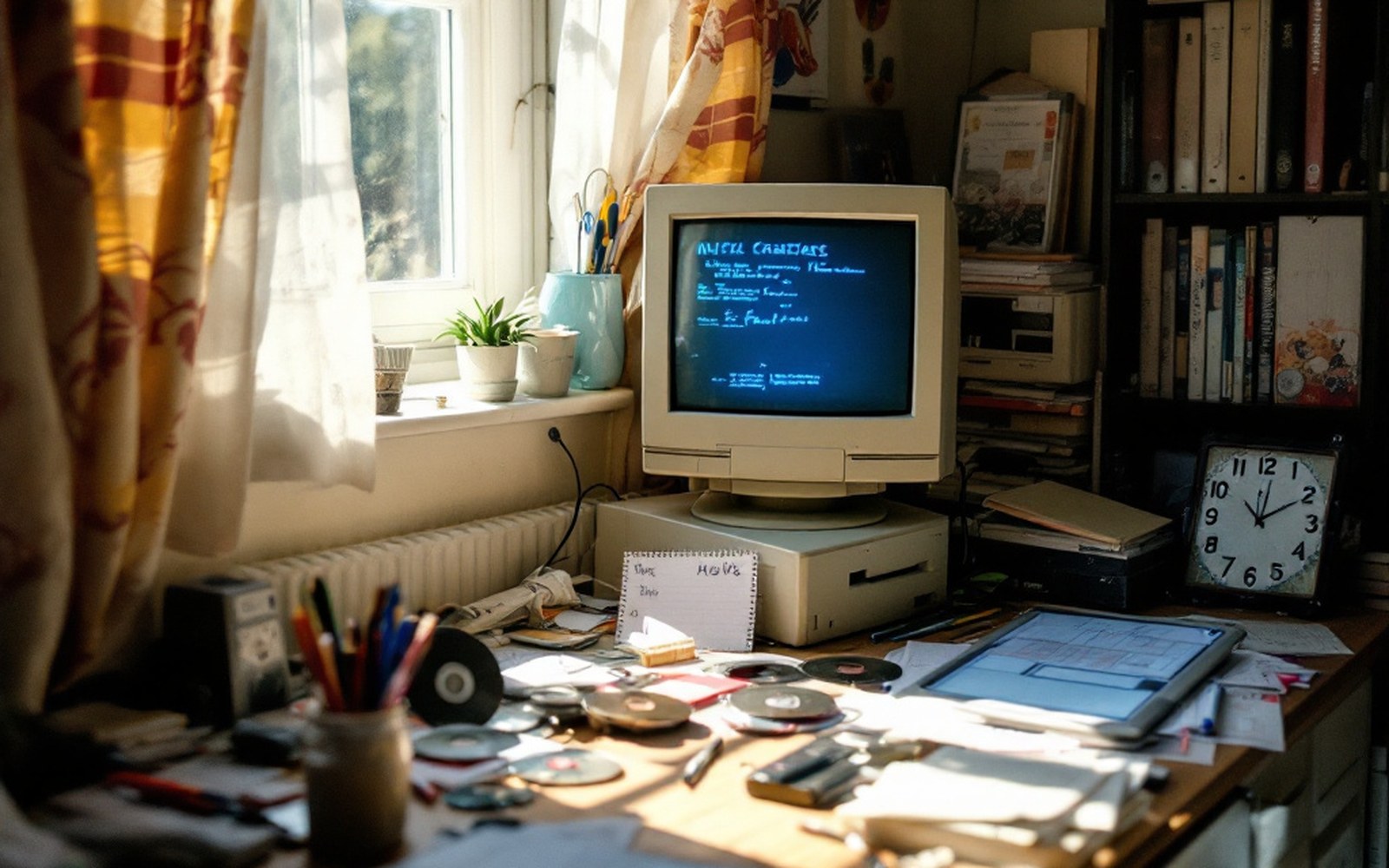
The upload culture ran on ordinary domestic hardware: burned discs, a tablet, and no gatekeeper.
oujouer.com collection
For the portals, this meant that every game distributed through their network carried their mark — a form of branding that scaled with catalogue size rather than media spend. For the sponsored-game model, the logic went further: the advertiser paid for a game built around their product, and the preloader was the first thing a player saw, often the only thing a player remembered if the game proved forgettable. Some preloaders included a short animation or sound, extending the impression time beyond what any banner could claim.

A catalogue rather than a community — identical machines, identical sessions, nothing to log into.
oujouer.com collection
The practice ended when the delivery conditions changed. Broadband speeds eventually made the wait negligible; the block on Flash at the end of 2020 removed the runtime entirely. Preservation projects such as BlueMaxima's Flashpoint retain the preloaders intact inside the original SWF files, which means the sponsor logos outlasted the sponsorships, the portals and the slow-connection era that made the whole arrangement necessary.
Before a browser game started, it had to arrive — and on a mid-2000s ADSL connection, a two-megabyte Flash file could take half a minute to load.

Accounts, scores and a revenue share turned an upload into something a developer could invoice for.
oujouer.com collection